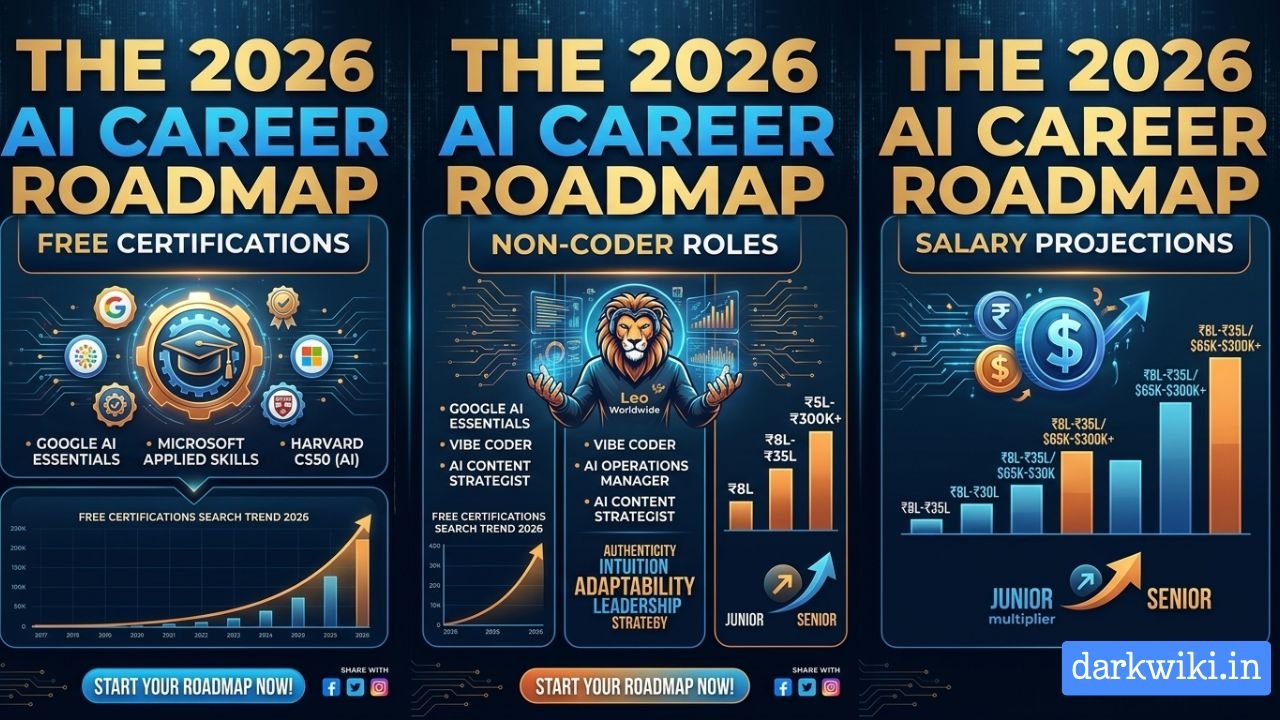
The artificial intelligence landscape has fundamentally shifted. If 2023 was about learning to chat with AI, 2026 is about building AI systems that work for you. The focus has moved from standard prompt engineering to Agentic AI (systems that execute tasks autonomously) and Vibe Coding (using natural language to build software without writing traditional code).
The best part? You do not need a computer science degree to capitalize on this shift. For professionals looking to future-proof their careers, this is your ultimate 2026 roadmap covering the most lucrative non-technical roles, global and regional salary benchmarks, and the exact free certifications you need to get hired.
1. The Rise of “Non-Coder” AI Roles in 2026
The barrier to entry for tech has never been lower. Companies are no longer just hiring Python developers; they are desperately seeking professionals who understand business logic and can direct AI to solve operational bottlenecks.
Here are the top non-coder AI roles dominating the 2026 job market:
Vibe Coders (Natural Language Developers): The evolution of the prompt engineer. Vibe coders use plain English (or regional languages) to instruct AI coding assistants to build websites, apps, and internal tools. You manage the “vibe” and intent, while the AI writes the syntax.
AI Operations Managers (AIOps): Perfect for those with a background in logistics, supply chain, or traditional business. This role involves integrating AI agents into daily company operations—automating customer service, supply routes, or inventory management.
AI Content Strategists: Marketing and digital design have been completely overhauled. This role uses advanced multimodal AI (text, image, and video models) to generate massive digital campaigns, website layouts, and copyright-free branding at scale.
2. AI Salary Projections: India vs. Global (2026 Data)
Because AI development is largely remote-friendly, professionals in tech hubs like India are seeing massive wage growth. However, compensation heavily depends on whether you are working for a local firm or contracting globally.
Here is the realistic 2026 salary breakdown for AI interaction designers and prompt specialists:
Pro Tip for Higher Salaries: The professionals commanding the highest pay aren’t just holding certificates. They are building public portfolios showing how they saved a company 40 hours a week using AI automation
3. Top Free AI Certifications to Boost Your Resume
You do not need to spend thousands of dollars on boot camps. The biggest tech companies in the world are currently giving away elite training for free.
Note: For platforms like Coursera and edX, always select the “Audit this course” option to access the learning materials for free without paying the certificate fee.
A. For Absolute Beginners & Business Owners
Google AI Essentials (via Coursera)
What you learn: The absolute fundamentals of generative AI, basic prompt engineering, and how to use AI to speed up daily workplace tasks (emails, spreadsheets, brainstorming).
Time commitment: Under 10 hours.
Why it matters: It is the fastest way to get a recognized Big Tech name on your resume.
B. For Future Vibe Coders & Automation Experts
Microsoft Azure AI Fundamentals (AI-900 via Microsoft Learn)
What you learn: How enterprise-level AI works. You will learn about computer vision, natural language processing, and how businesses deploy AI agents securely.
Time commitment: Self-paced (approx. 15 hours).
Why it matters: Microsoft is deeply integrated into global corporate environments. Knowing their AI ecosystem makes you highly employable to traditional businesses.
C. For The Ambitious (Technical Foundation)
CS50’s Introduction to AI with Python (Harvard University via edX)
What you learn: This is the most rigorous free course available. While it touches on Python, the real value is learning the logic behind how AI searches, plays games, and learns.
Time commitment: 7–12 weeks.
Why it matters: Completing a Harvard-backed tech course proves to employers that you have the discipline to handle complex, high-level problem-solving.
D. The “Hidden Gem” for Non-Tech Thinkers
Elements of AI (University of Helsinki)
What you learn: Demystifies AI completely without a single line of math or code.
Time commitment: 30–40 hours.
Why it matters: It is globally recognized and completely free (including the digital certificate), designed specifically to educate the general public on how AI impacts society and business.
Final Takeaway for 2026
Certificates will get you past the HR resume scanners, but execution gets you the job. Pick one free course above, finish it this month, and immediately use that knowledge to build a small AI project—whether that is automating your own emails, generating a marketing website, or creating a custom workflow for a local business.
Related:
Vibe Coding vs Prompt Engineering in 2026 The Future of AI Development
